Documentation menu
Collaboration
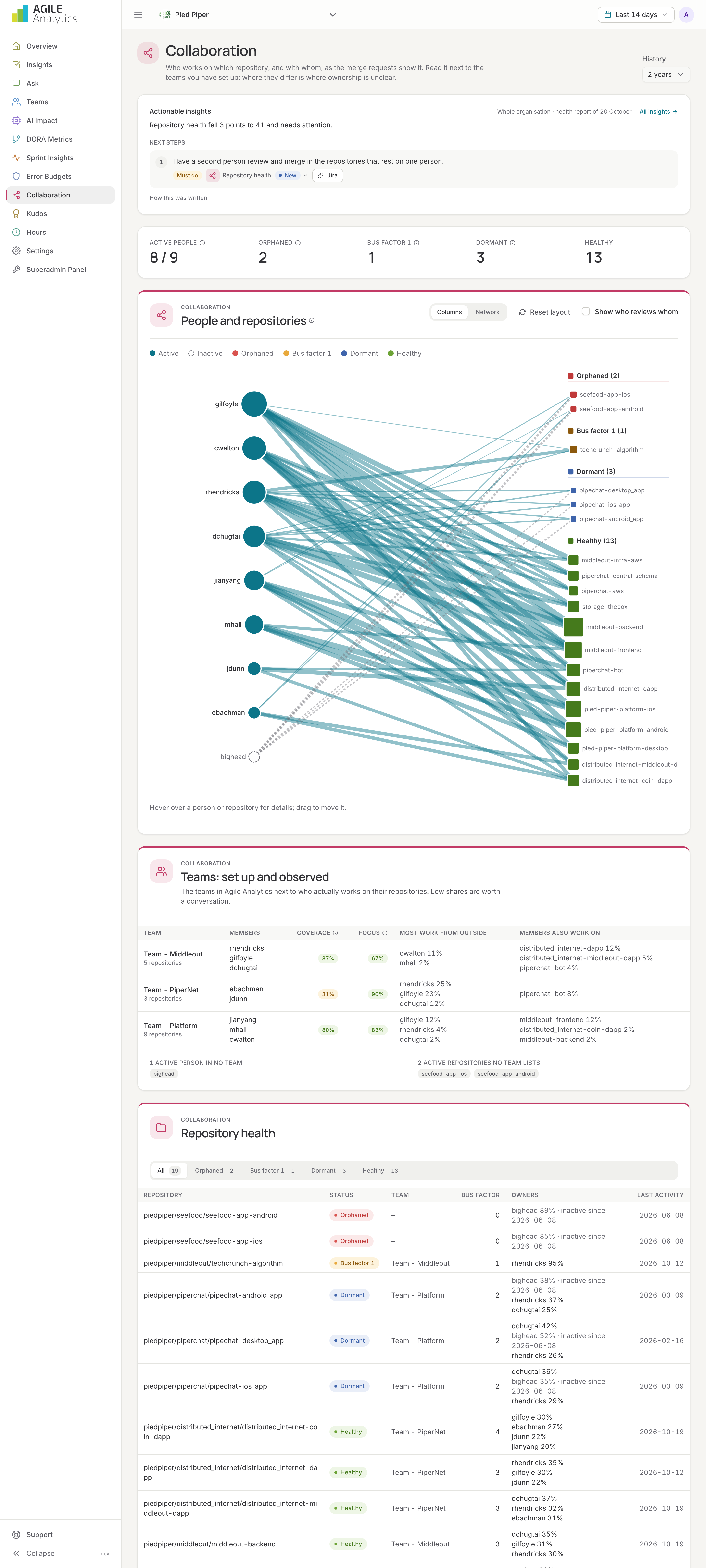
Collaboration shows who works on which repository, and with whom, as the merge requests show it. Read it next to the teams you have set up: where they differ is where ownership is unclear.
What it reads
Merge request events only: authoring, reviewing, approving and merging, from the repositories with a webhook. Recent work counts more: its weight halves every 90 days. Someone who works in repositories without the webhook, or pushes straight to the main branch, looks inactive here. Accounts with the same full name or a near-identical username are treated as one person. The graph is rebuilt every night; pick how many years of history it covers at the top of the page.
Summary
The cards count the active people (merge request activity in the last 90 days, out of everyone seen in the period) and the repositories by status:
| Status | Meaning |
|---|---|
| Healthy | Active, and the work is spread over more than one person |
| Bus factor 1 | Only one active person holds at least 10% of the work |
| Dormant | No activity for 180 days, but the people who know it are still around |
| Orphaned | None of the people who know it has been active anywhere recently |
People and repositories
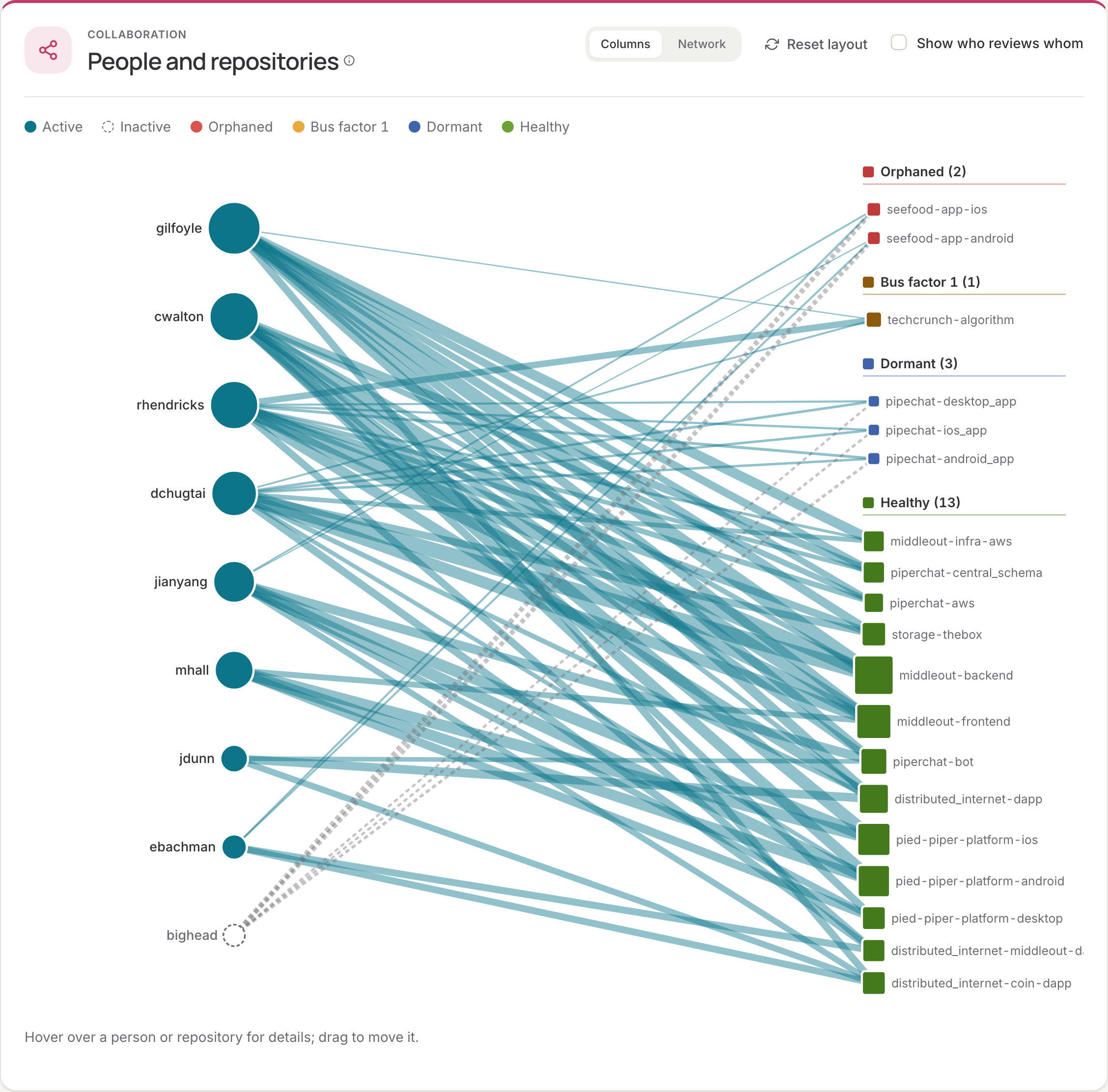
Circles are people, squares are repositories; size is the amount of work. People without activity for 90 days are drawn hollow with dashed lines. Hover a person for their main repositories and aliases, hover a repository for its owners, bus factor and last activity; drag to move things. Switch on Show who reviews whom to draw the review and approval ties between people, and switch between a network and a column layout.
Repository health
The table lists every repository with its status, bus factor, owners, last activity and the team that lists it. Filter by status to see, for example, all repositories that rest on one person.

Teams: set up and observed
The teams in Agile Analytics next to who actually works on their repositories:
- Coverage: the share of the work on the team's repositories done by its members.
- Focus: the share of the members' work that is on the team's own repositories.
- Most work from outside and Members also work on name the people and repositories behind a low share.
Low shares are worth a conversation. The page also counts active people in no team, active repositories no team lists, and members without a linked Git account.
Where collaboration is used
- Repository health, one of the eight health areas: the share of repositories that are healthy.
- The Collaboration tile on the overview and the team health ring.
- Signals: a message when a repository comes to rest on one person or has nobody active left.
- The Teams page's network diagram and the assistant's answers about who works on what.
Collaboration is part of the Scale-Up and Enterprise plans.