DORA vs SPACE: which engineering metrics framework do you need?

Published on 18 August 2026 by Zoia Baletska

"Should we use DORA or SPACE?" is a question with a hidden assumption in it — that the two are alternatives, and picking one means not picking the other. They are not the same kind of thing. DORA is a fixed set of four metrics. SPACE is a framework for deciding what to measure, which does not name a single metric you must collect. You can implement DORA. You cannot really implement SPACE; you can only use it to choose.
What DORA is
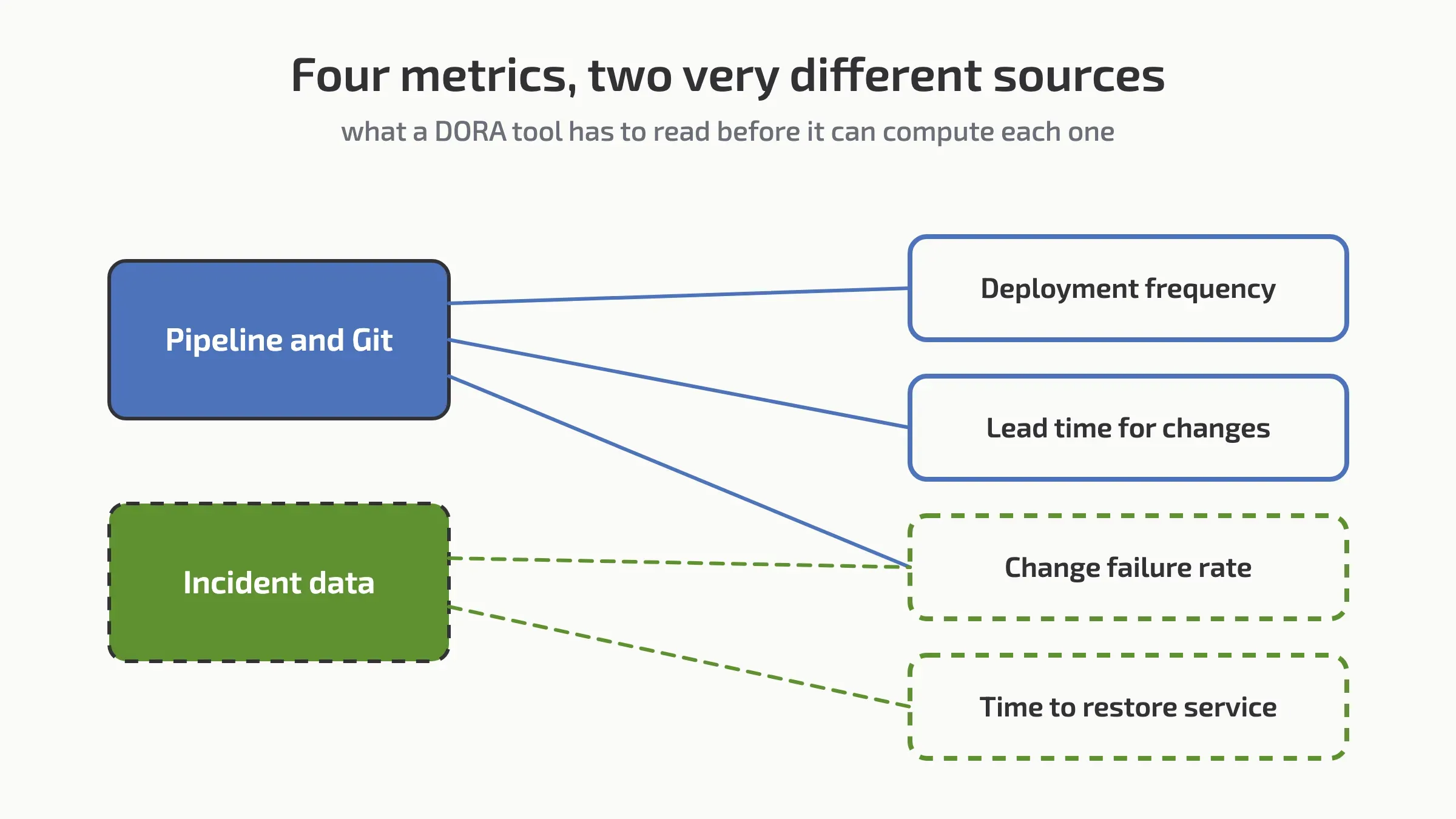
The DORA metrics are four measurements of how software gets from a developer's machine into production:
They describe throughput (items finished per week) and stability at the level of the delivery system, and they are deliberately few. That is the strength: four numbers with agreed definitions, all derivable from tooling you already run, comparable between teams because everyone means the same thing by them.
Deployment frequency — how often you release to production
Lead time for changes — from commit to running in production
Change failure rate — the share of releases that cause a problem
Time to restore service — how long recovery takes when one does
What SPACE is
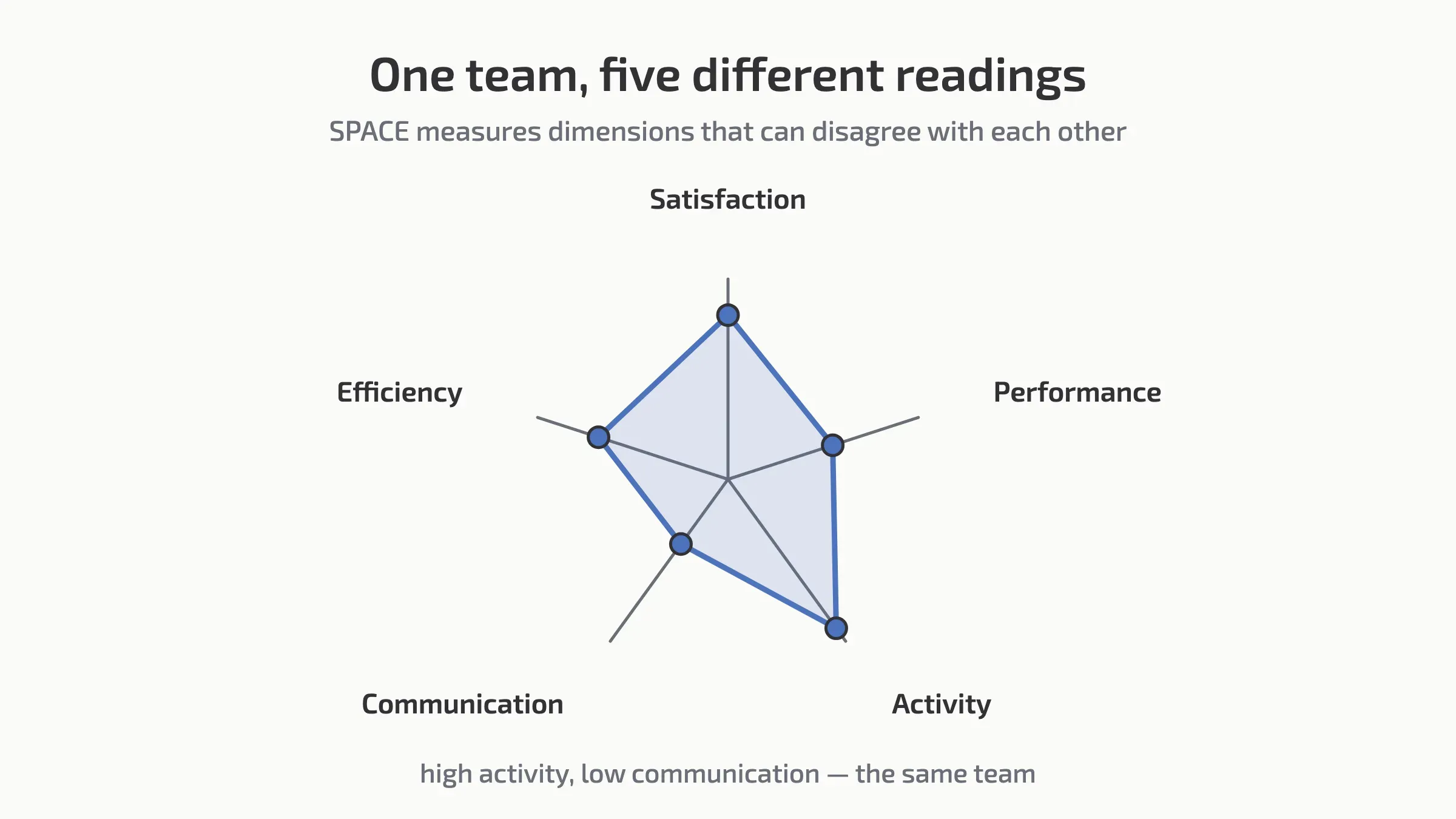
SPACE is not a metric set. It is an argument about what a metric set has to cover before it can be trusted, organised into five dimensions:
The guidance that comes with it matters more than the letters. Pick metrics from more than one dimension. Include at least one that comes from asking people rather than from a system. Never report a single number as "productivity". SPACE exists because teams kept measuring the one dimension that was easy to instrument and then acting as though it described the whole.
Satisfaction and well-being — how developers feel about the work and the tools
Performance — outcomes of the system, not output of the person
Activity — counts of things done, the easiest to collect and the easiest to misread
Communication and collaboration — how work and knowledge move between people
Efficiency and flow — progress with minimal interruption and waiting
Where they overlap, and where they do not
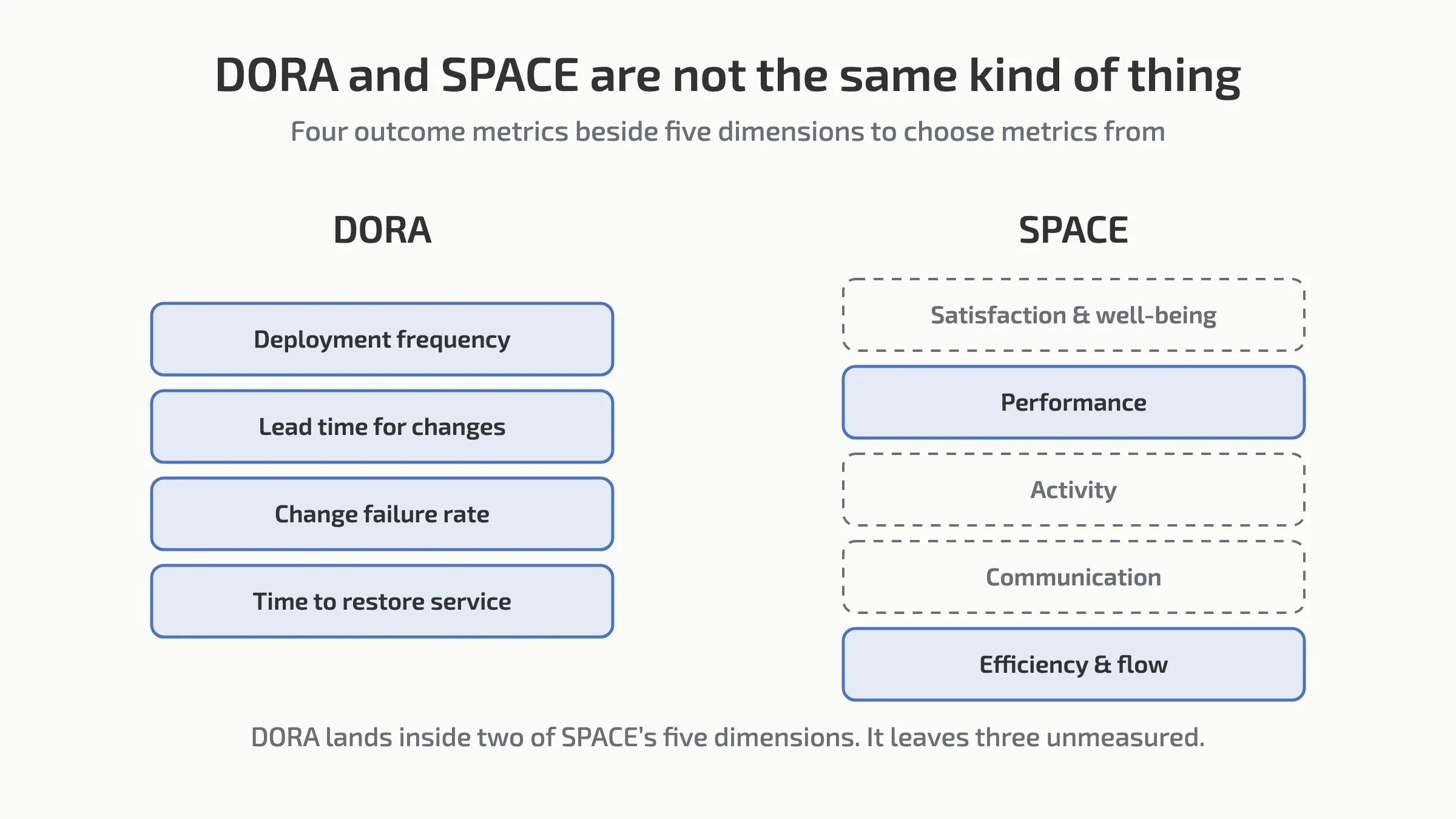
Map DORA's four onto SPACE's five and they land in two dimensions: Performance and Efficiency and flow. That is not a criticism — those are the two dimensions a delivery organisation most needs an objective read on, and DORA gives you one that does not depend on anybody's self-report.
But it does mean that a team measuring only DORA has three dimensions unmeasured. Satisfaction, collaboration and activity are simply not in the frame. A team can post excellent DORA numbers while the people producing them are heading for the door, and nothing in the four metrics will say so.
The failure mode each one has
DORA's failure mode is treating four system-level metrics as a scorecard for individuals or teams. The moment deployment frequency becomes a target, it stops measuring delivery and starts measuring how work is split into deployable chunks. The research the metrics come from is about organisational capability, not about ranking teams against each other.
SPACE's failure mode is the opposite: it is a framework, so it can be agreed with in a workshop and then never turned into anything. Five dimensions and no prescribed metrics means someone has to do the work of choosing, and "we use SPACE" is a sentence that can be true while nothing is being measured at all.
So which one do you need?
If you have nothing today, start with DORA. It is defined, it is comparable, and the data comes out of your own pipeline and issue tracker without asking anyone to fill in a survey. It also gives you the fastest honest answer to "are we getting faster or not", which is usually the question that prompted the search in the first place.
Use SPACE as the check on what you have built. Once the four are running, walk the five dimensions and ask which ones you are blind to. In practice the answer is satisfaction and collaboration, and the fix is not another dashboard. It is a recurring question put to the people doing the work, reported next to the delivery numbers rather than instead of them.
The pairing is what makes either useful. DORA tells you what the system did. SPACE stops you from concluding that the system is the whole story.
Making them one view
The practical obstacle is rarely disagreement about frameworks — it is that the numbers live in different places. Deployment data is in the pipeline, change failures are in the incident tool, flow is in the issue tracker, and satisfaction is in whatever survey someone ran last quarter. Four sources, four refresh rates, and no way to see whether the week delivery got faster is the same week the interruptions went up.
Agile Analytics pulls the delivery side — DORA metrics, flow and cycle time against lead time — from the systems that already produce it. So the objective half of a SPACE-shaped picture is in one place and stays current. What you add beside it is the part only your people can answer.
Less guessing. More shipped software.
Measure faster — lead time, review wait and deployment frequency per team, every sprint
Guard quality — change failure rate, MTTR and Error Budgets
Prove the gain — feature work versus maintenance, from your own data
See it in 30 minutes — on your own data, not a slide deck