DevEx vs. SPACE: How to Measure Developer Experience the Right Way

Published on 29 January 2026 by Zoia Baletska
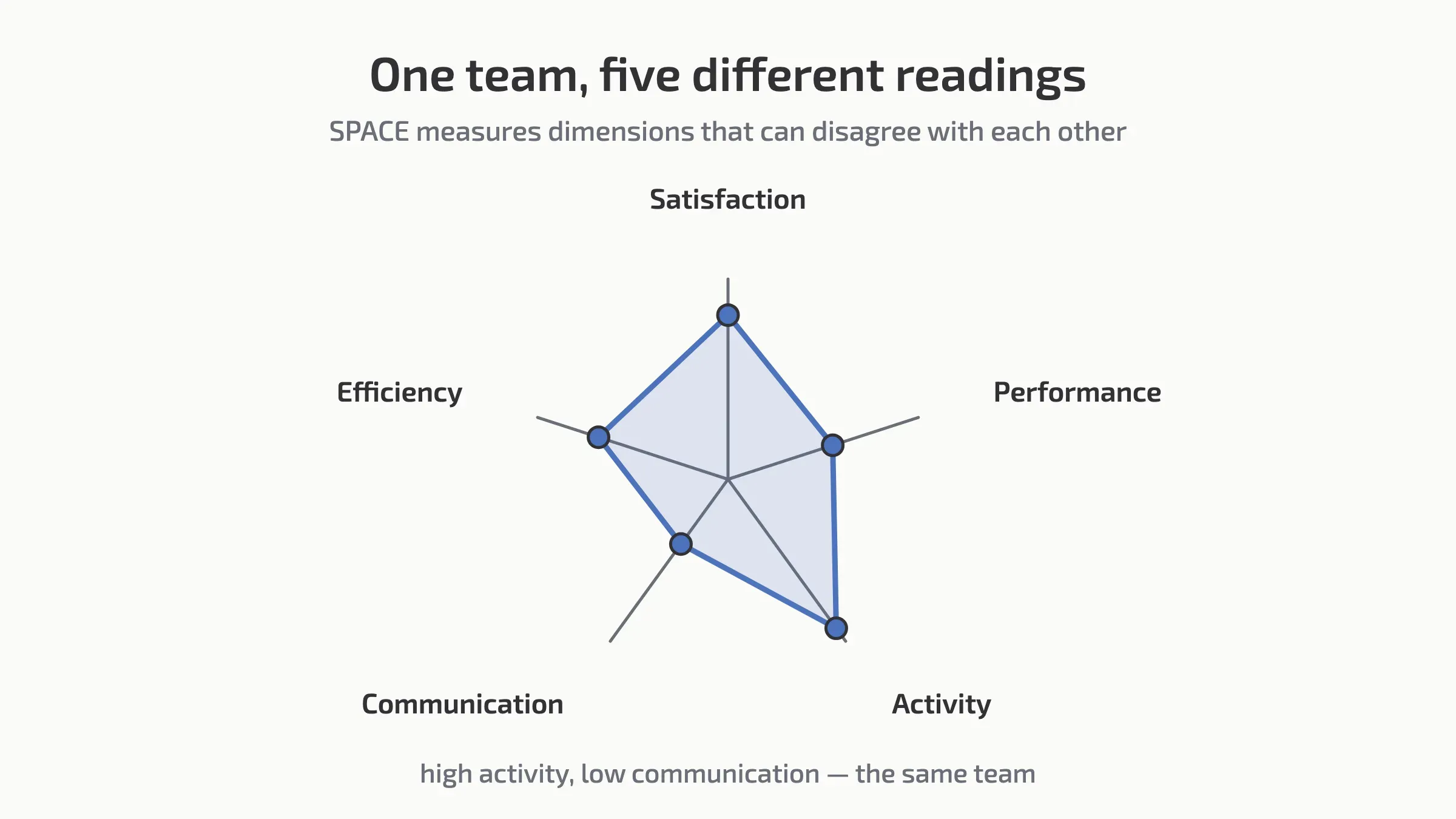
In the rapidly evolving world of software development, the old notion of “productivity = more code” is long dead. Modern engineering teams recognise that sustainable performance depends not just on output, but on the developer experience (DevEx) that underlies it.
Two influential frameworks have emerged to help teams think about this holistically: SPACE and DevEx. Each offers a structured way to capture what matters — but they serve slightly different purposes and deliver different insights.
In this article, we’ll explain both frameworks, compare them, and show how they can complement each other in a modern engineering organisation.
Why traditional metrics fall short
Historically, teams have relied on simple indicators like commit counts, lines of code, or deploy frequency to judge productivity. These single-dimensional metrics are easy to collect — but they miss the why and how behind development outcomes. For example, a spike in commits could mean more work being done… or more churn and rework.
To address this, researchers and engineering leaders have created multi-dimensional models that look beyond volume or speed.
Enter the SPACE framework
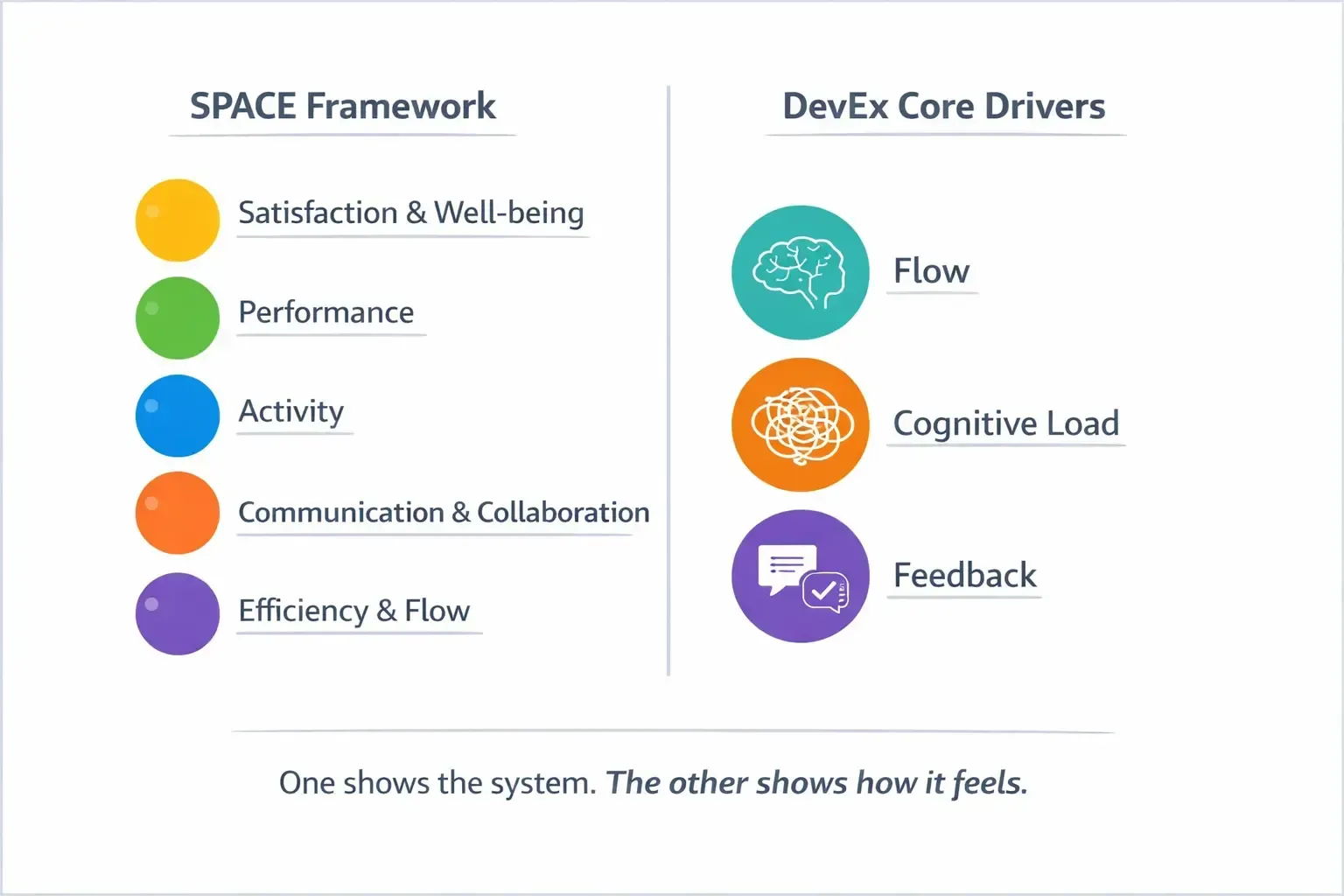
The SPACE framework was introduced by researchers from Microsoft, GitHub, and others to provide a multi-faceted view of developer productivity. SPACE stands for:
-
Satisfaction & Well-being (how developers feel about their work)
-
Performance (how well the work achieves intended outcomes)
-
Activity (the actions developers perform)
-
Communication & Collaboration (how work flows between people)
-
Efficiency & Flow (how smoothly developers can work)
A recent study used the SPACE dimensions to evaluate software engineers by mining activity data and analysing collaboration patterns — a rigorous attempt to quantify productivity in context, rather than relying on single-number heuristics.
The SPACE framework acknowledges two important truths:
-
Productivity and experience are multi-dimensional — focusing on one metric can distort reality.
-
Quantitative data (commits, PRs (a proposed code change awaiting review)) must be balanced with qualitative signals (satisfaction, collaboration).
For example, the SPACEX research paper (2025) operationalises SPACE metrics using repository mining and statistical models to show that traditional metrics like commit count often miss deeper aspects like collaboration and developer satisfaction.
What is Developer Experience (DevEx)?
While SPACE spans productivity and experience dimensions, the DevEx (Developer Experience) framework zeroes in specifically on the human experience of developers. It was articulated in research by Abi Noda, Dr. Nicole Forsgren, Dr. Margaret-Anne Storey and others as a response to the gap left by output-centric models.
DevEx focuses on three core aspects:
-
Feedback loops — speed and quality of feedback developers receive
-
Cognitive load — the mental effort required to complete work
-
Flow state & context switching — how well developers can focus on meaningful work without interruption
In practice, DevEx adds a psychological and experiential layer that complements quantitative measurement. Instead of a laundry list of metrics, it provides a lens for diagnosing friction points and developer well-being that directly affect long-term productivity.
DevEx is less about aggregating signals into a composite score and more about understanding how work feels for developers — especially in the presence of complex tooling, collaboration challenges, and contextual overhead.
DevEx vs. SPACE — Side-by-Side Comparison
Here’s how the two frameworks compare in focus and purpose:
Dimension
Primary Goal
Origin
Core Focus
Perspective
Data Sources
Strengths
Limitations
Best Use Case
Role in Measurement
SPACE Framework
Measure developer productivity holistically
Microsoft, GitHub, academic research
Outcomes, activity, collaboration, efficiency, satisfaction
System-level, organisational
Repo mining, PRs, tickets, surveys
Prevents single-metric fallacies; enables balanced dashboards
Can mask individual pain points
Tracking trends across teams over time
What is happening
Developer Experience (DevEx)
Understand and improve how development feels
Built on SPACE by Storey, Forsgren, Noda
Cognitive load, feedback loops, flow
Human-centred, experiential
Surveys, interviews, workflow diagnostics
Reveals friction, burnout risk, and learning issues
Less suited for benchmarking output alone
Diagnosing why productivity changes occur
Why it’s happening
This distinction is also reflected in recent empirical research. The SPACEX study (2025) demonstrates that productivity signals only emerge when multiple SPACE dimensions are analysed together — especially when collaboration and satisfaction are included alongside activity metrics.
At the same time, research on AI-assisted development using the SPACE framework shows that improvements in activity or performance do not always go together with improved satisfaction or well-being. That reinforces the need for DevEx-style measurement (Microsoft Research, SPACE of AI).
How they complement each other
Rather than thinking in terms of “one vs. the other,” high-performing teams typically blend both frameworks:
✔ Use SPACE to
-
Quantify productivity across teams
-
Create composite views that mix satisfaction, flow and output
-
Benchmark changes over time across dimensions
✔ Use DevEx to
-
Diagnose sources of frustration or burnout
-
Improve workflow design and tooling
-
Prioritise changes based on developer feedback
Together, SPACE gives you the what, and DevEx helps explore the why.
When to use which?
Use SPACE when:
-
You want a broad view of engineering performance
-
You’re building dashboards that combine activity, satisfaction, efficiency, and more
Use DevEx when:
-
You need to root out friction and flow blockers
-
You want to improve onboarding, satisfaction, and long-term retention
And often, the best answer is: Start with SPACE to detect trends → use DevEx to diagnose root causes.
Beyond frameworks — towards holistic metrics
Frameworks are guides, not laws. The real value comes from:
-
Combining system data (repo, CI/CD (the automated build, test and release of every change), tooling logs),
-
With developer sentiment and perception surveys,
-
And qualitative feedback loops embedded in team retrospectives (the team’s end-of-sprint review of how it worked).
For example, fast deployment times may hide poor satisfaction scores, or high commit frequency may hide high context switching and cognitive load. Space and DevEx help you see these patterns in tension rather than in isolation.
To truly improve engineering performance, you need both contextual awareness and human-centred measurement.
Why this matters more now (especially with AI)
Recent AI-focused studies using the SPACE framework show mixed results: some teams see faster delivery, while others experience slowdowns or reduced satisfaction. These findings underline a key insight from both SPACE and DevEx research:
Productivity gains that ignore developer experience are rarely sustainable.
As AI tools increase the volume of generated code and feedback, cognitive load, trust, and flow become even more critical metrics — ones that DevEx is specifically designed to capture.
Conclusion
Neither Space nor DevEx alone gives you a complete picture — but together, they unlock a balanced, sustainable view of software engineering health.
-
SPACE broadens your lens beyond single metrics.
-
DevEx deepens your understanding of developer well-being.
For teams adopting modern tools — including AI — these frameworks help you avoid being misled by simple metrics like commit counts or code velocity (story points completed per sprint). Instead, you get insight into both productivity and experience — essential for building high-performing, healthy engineering organisations.
SPACE is just as often weighed against DORA rather than DevEx, which is a different question with a different answer — DORA vs SPACE sets out where the two frameworks overlap and where they do not.
Less guessing. More shipped software.
Measure faster — lead time, review wait and deployment frequency per team, every sprint
Guard quality — change failure rate, MTTR and Error Budgets
Prove the gain — feature work versus maintenance, from your own data
See it in 30 minutes — on your own data, not a slide deck