The Missing Backstage Plugin: DORA Metrics, Error Budgets and AI Adoption in One View

Published on 3 November 2026 by Zoia Baletska
Most engineering numbers live in a dashboard nobody opens. Backstage is the developer portal your teams already open every day: the catalog of services, who owns them and their documentation. The Agile Analytics plugin for Backstage puts delivery, reliability and AI adoption on those same pages. The numbers sit next to the services and teams they describe.
What does the plugin add to Backstage?
Agile Analytics reads your Git host, CI/CD, Jira and monitoring, and turns them into one engineering health score per team. The plugin shows that inside Backstage. It adds an Agile Analytics page with eight tabs: Overview, DORA, Error budgets, AI adoption, Collaboration, Kudos, Sprints & hours and Trends. It also adds three cards to the catalog: the error budget of a service on its page, the error budgets of a team on its group page, and the delivery figures of a repository on its page.
The team and the period are kept in the URL. A view can be linked to, and it stays the same when you switch tabs. Every tab has a button that opens Agile Analytics itself for the detail.
How healthy is each team?
The Overview tab gives one engineering health score for the whole organisation or for a single team. The score combines three parts: DevEx, OpsEx and AgileEx. Each part is the average of its areas, such as AI adoption, repository health, delivery, reliability, flow and sprint predictability. Every area shows its trend and whether it is on track or needs attention.
Below the score are the four DORA metrics and the recent signals: what changed in the last two weeks, found every morning. A signal names the service, repository or team it is about. Examples are an SLO over its error budget, or a repository that now rests on one person. Pick a period of 7, 14, 30 or 90 days.
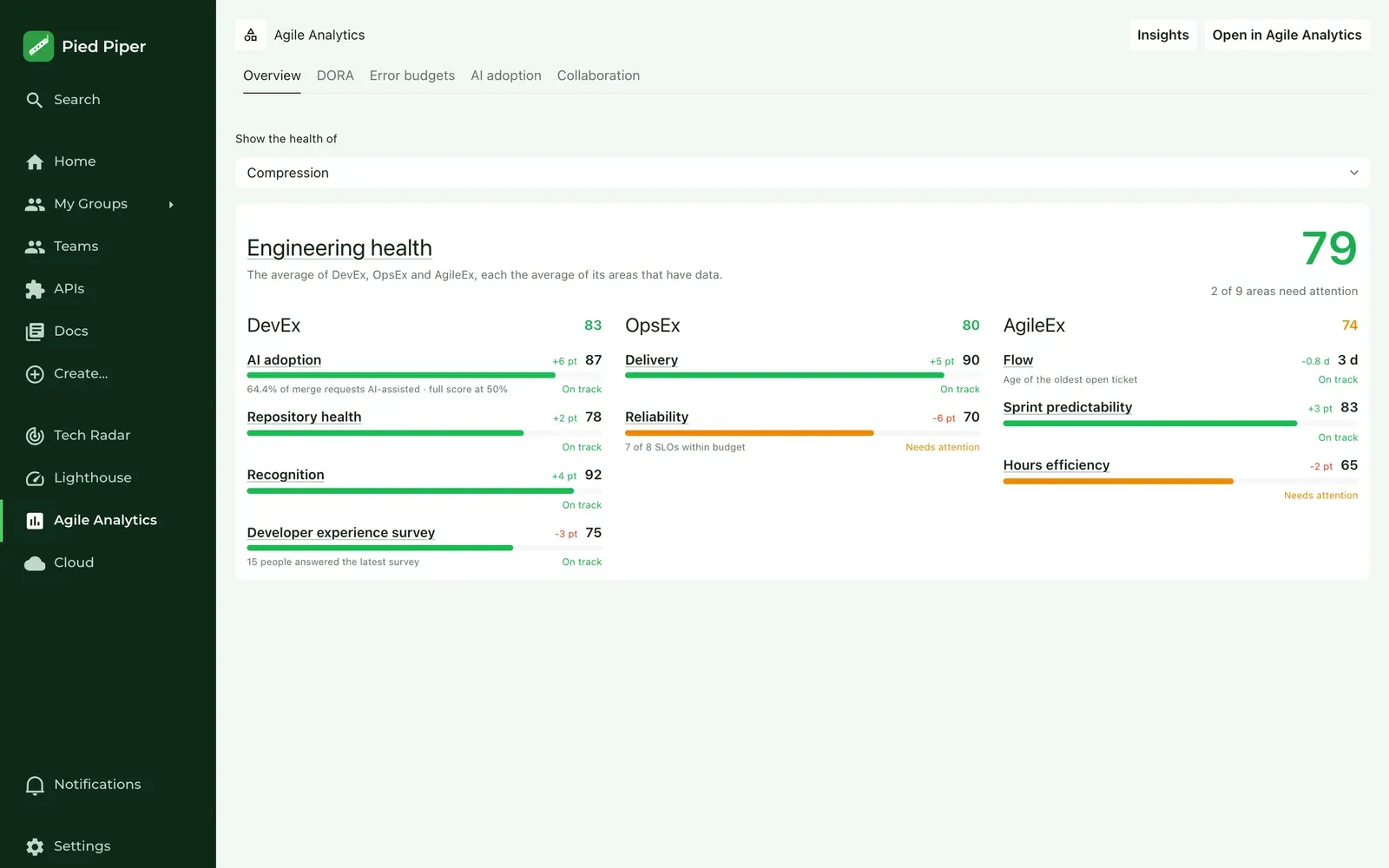
The Overview tab for one team: a health score of 79, built from DevEx, OpsEx and AgileEx. Sample data.
Which DORA metrics does it show?
The DORA tab shows the four DORA metrics. Deployment frequency is how often you release. Lead time for changes is how long a change takes from merge to production. Time to restore is how long it takes to recover from a failed deployment. Change failure rate is the share of deployments that need a fix.
Each metric carries its DORA benchmark level, from Low to Elite. A chart shows the deployments per day and marks the ones that needed a fix. Per repository you see the deploys, the failure rate and the lead time. Narrowed to one team, the tab uses the repositories that team deployed from.
The deployments that needed a fix are found automatically. The plugin looks for hotfixes, reverts and SLO alerts right after a deployment, and shows how long restoring took. Nobody has to tag a failed release by hand.
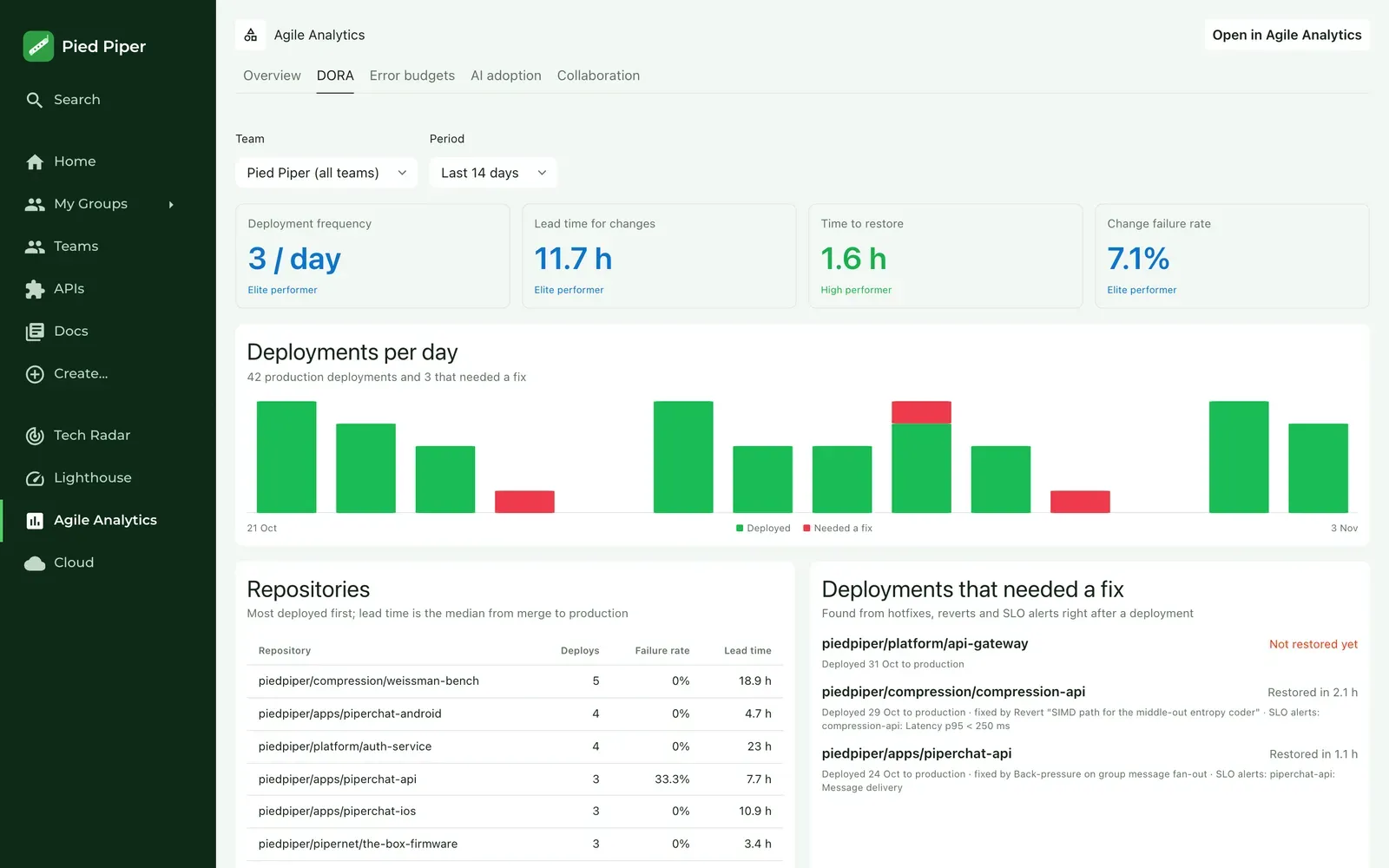
The DORA tab: the four metrics with their level, deployments per day, and the deployments that needed a fix. Sample data.
Which services are over their error budget?
An SLO, or service level objective, is a reliability target, such as 99.5% of messages delivered. The error budget is how much unreliability a service may still spend before it misses that target. The Error budgets tab lists every SLO with the budget it has left, lowest first. The service that is over budget is at the top.
Each SLO shows how its budget moved over the period, and per week. The tab can be narrowed to one team, so a team sees only the services it runs.
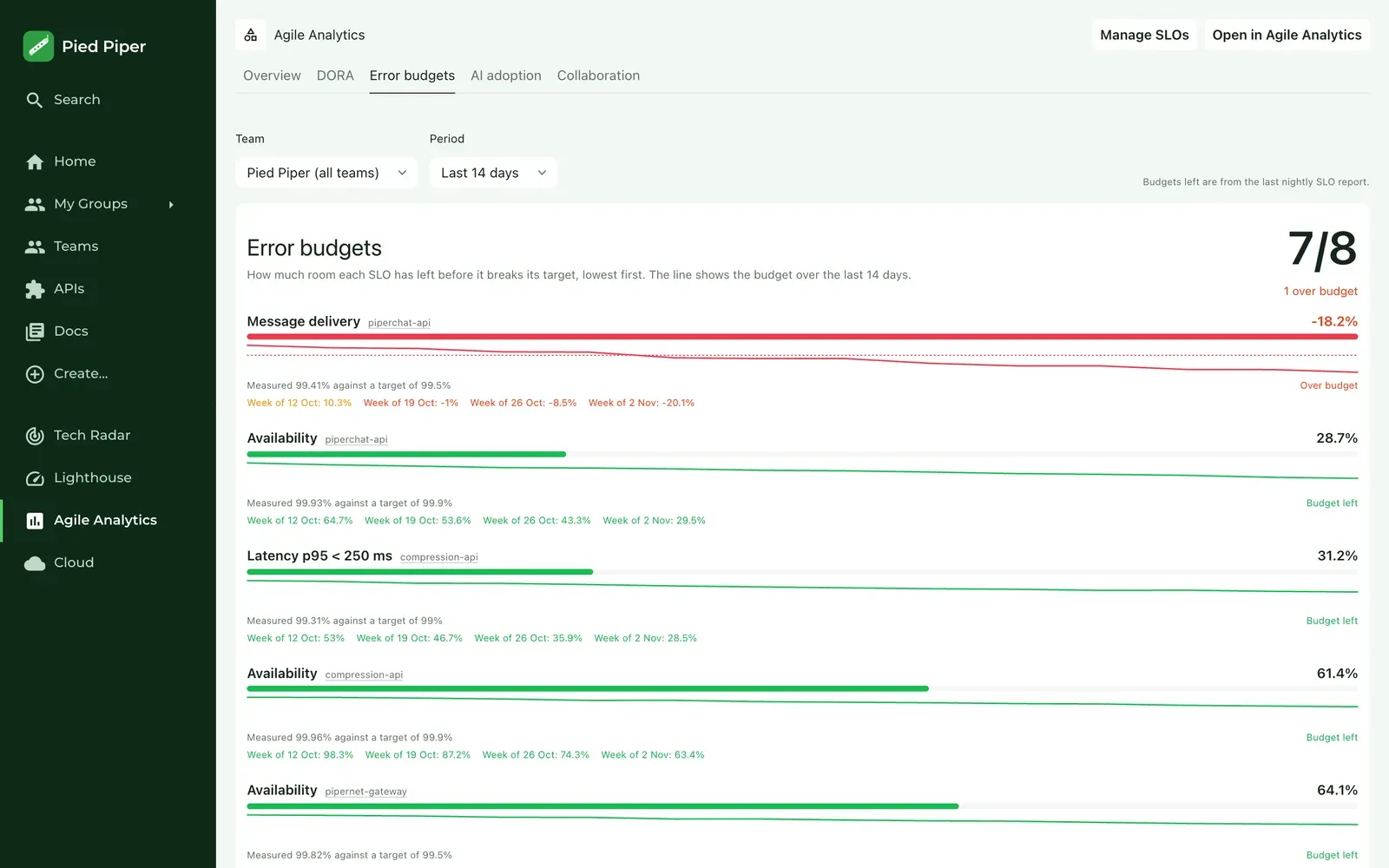
The Error budgets tab: every SLO with the budget it has left, lowest first. Sample data.
The same budgets appear on the page of each service in the Backstage catalog. The error budget card shows the SLOs of that one service. The team that owns the service sees its budget where it already works. One annotation in the service's catalog-info.yaml links it to the service name its SLOs use:
1metadata:
2  annotations:
3    agileanalytics.cloud/service: api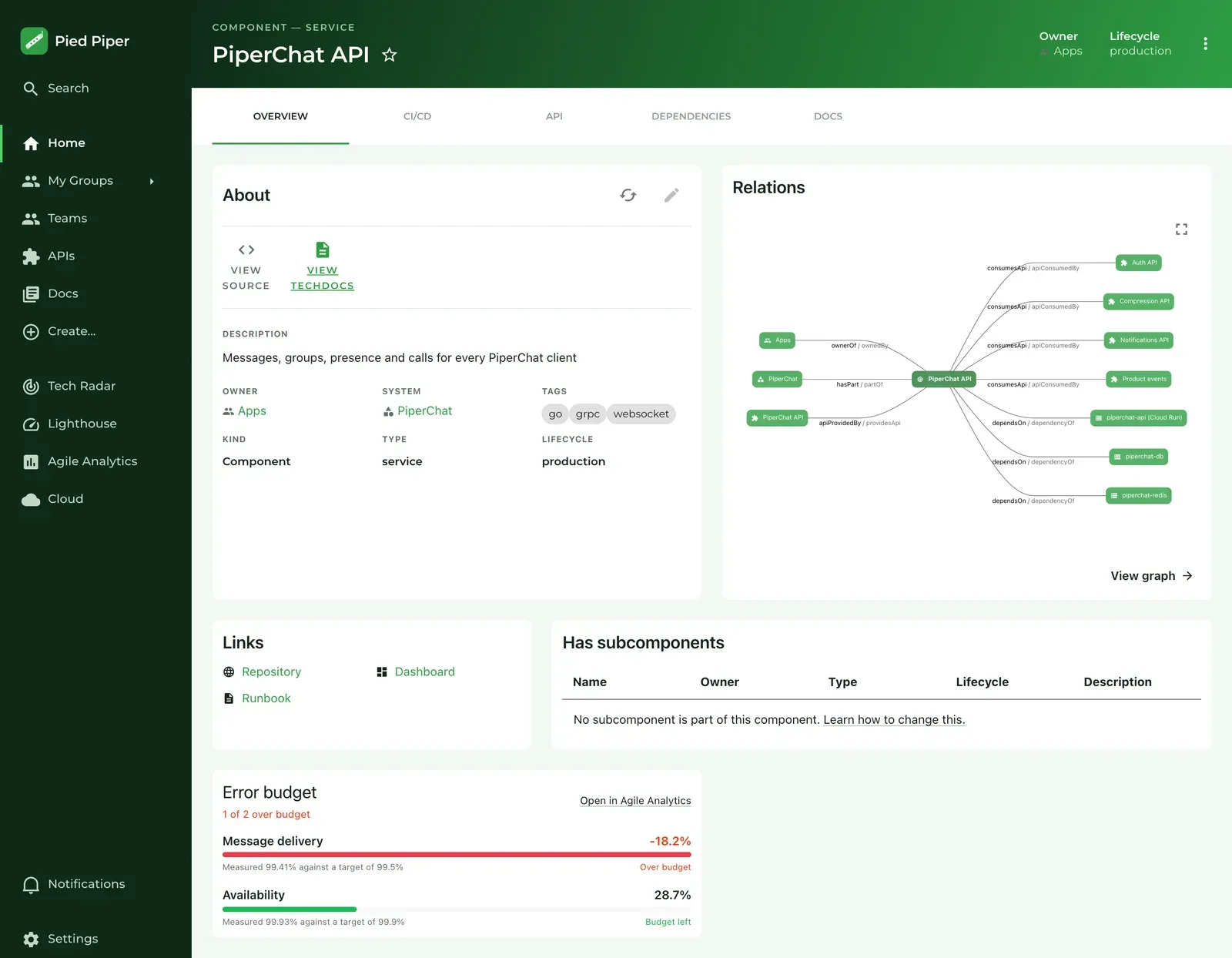
A service page in the Backstage catalog with the Agile Analytics error budget card at the bottom. Sample data.
Is AI actually helping your teams?
Most organisations know how many AI licences they pay for. Few know what those licences return. The AI adoption tab measures the share of merged work that AI helped with. It shows that per repository and per tool, such as Claude Code, GitHub Copilot and Cursor, against an adoption target.
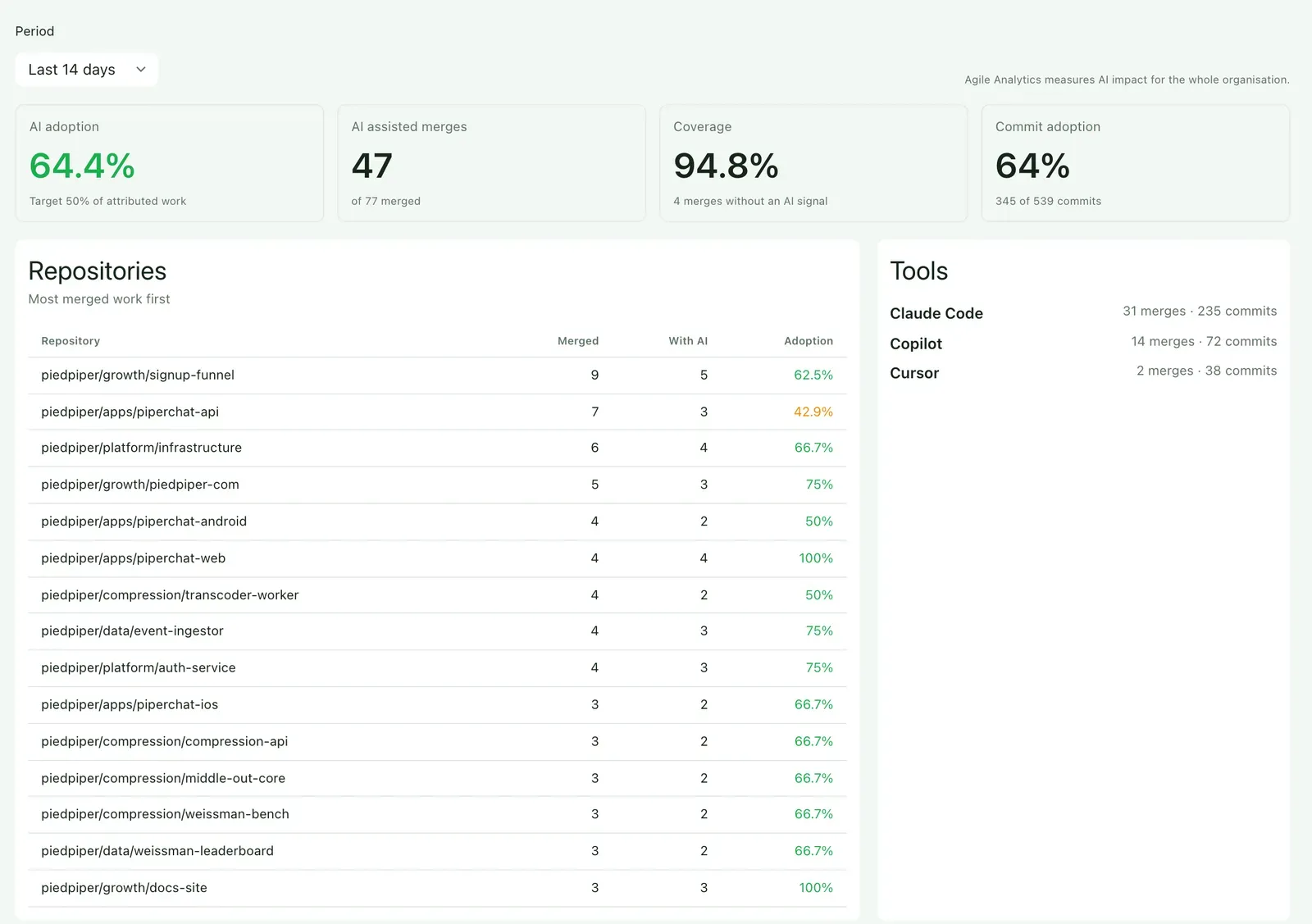
AI adoption against a target, per repository and per tool. Sample data.
Usage alone says little, so the tab compares AI-assisted work with the other work in the same repositories. Speed is the time to first approval, to merge and to deploy. Quality is the change failure rate and the rework: merged work that was reverted or fixed within 14 days. Cost and return sets what the AI tools cost against the hours they saved.
AI adoption is measured for the whole organisation, not per team. The question it answers is a leadership one: does the spend pay off, and does quality hold while it does?
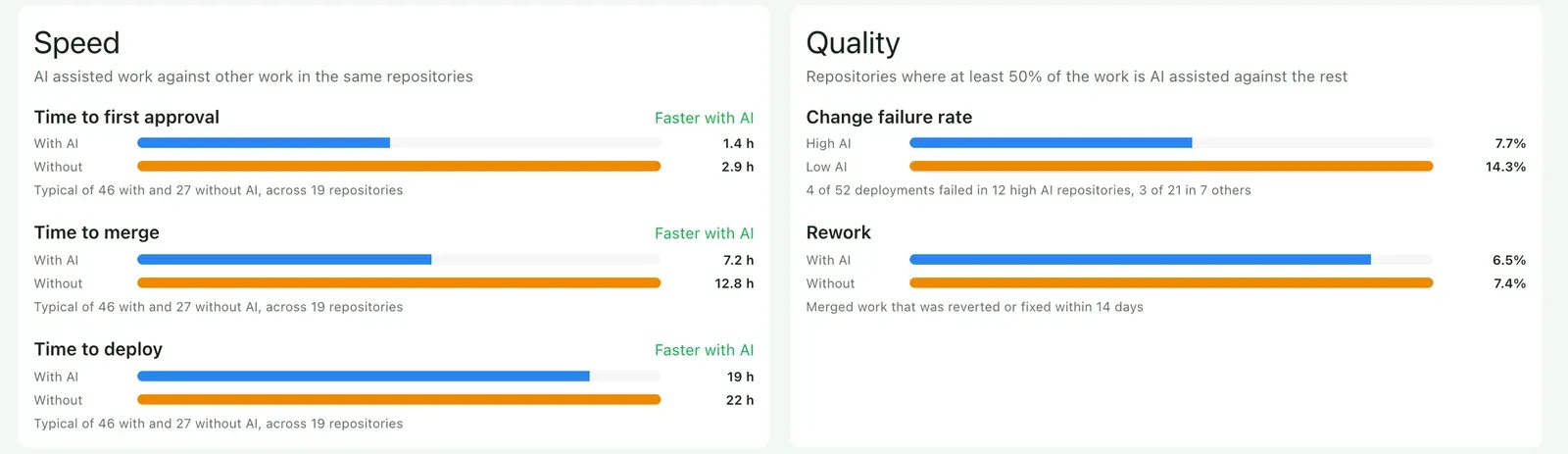
Speed and quality of AI-assisted work against other work in the same repositories. Sample data.
Who reviews the code, and who owns it?
The Collaboration tab covers code review and ownership, per team and per repository. For code review it shows how much was merged, how much was merged without approval, the wait for the first approval and the time from open to merged.
For ownership it marks each repository as orphaned, at risk, dormant or healthy. The bus factor is how many active people know a repository. The tab lists the repositories that need an owner first, with their bus factor and who knows the code today. That is knowledge you want to spread before someone leaves, not after.
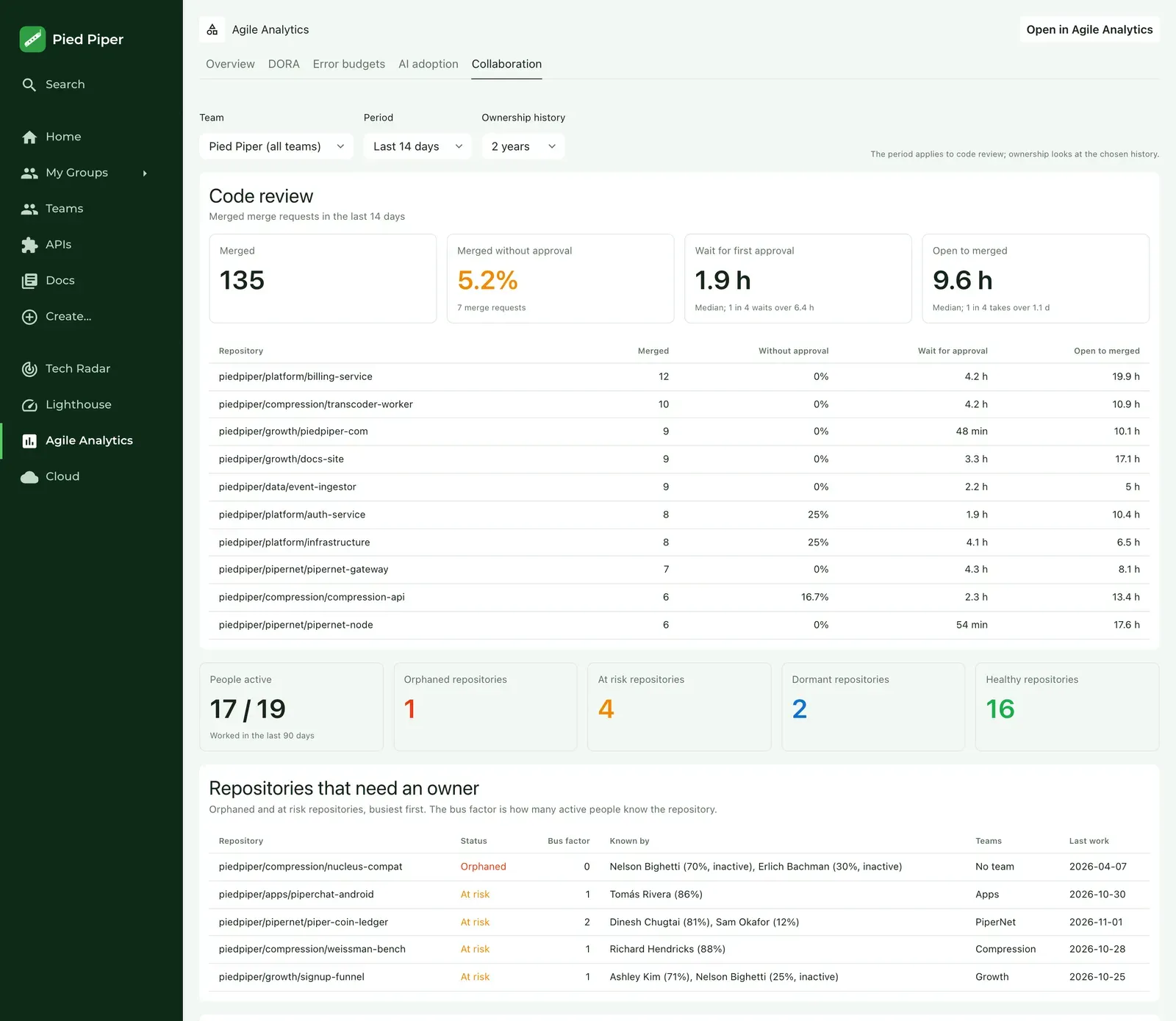
The Collaboration tab: code review per repository, repository health, and the repositories that need an owner. Sample data.
How do you set it up?
The plugin is free and open source, under the Apache-2.0 licence. The code is on GitHub, and npm has it as @zensoftwarenl/backstage-plugin-agile-analytics with its backend, @zensoftwarenl/backstage-plugin-agile-analytics-backend. The backend holds your Agile Analytics API key, so browsers only ever talk to Backstage, and only signed-in users can. Setting it up takes three steps:
Add both packages to your Backstage app and backend, and register the backend plugin.
Put your organisation and an API key in app-config.yaml.
Link each service to its SLOs with the annotation shown above, and each repository with
agileanalytics.cloud/repository.
1yarn --cwd packages/app add @zensoftwarenl/backstage-plugin-agile-analytics
2yarn --cwd packages/backend add @zensoftwarenl/backstage-plugin-agile-analytics-backend
3
4// packages/backend/src/index.ts
5backend.add(import('@zensoftwarenl/backstage-plugin-agile-analytics-backend'));
The plugin itself costs nothing. Its data comes from your Agile Analytics organisation: health, DORA, Kudos and Sprints & hours from Start-up, and error budgets, AI adoption, collaboration and Trends with Scale-Up, in Backstage as in the app. No account yet? Demo mode shows the whole plugin with made-up data, so you can try it in your own Backstage first. The Backstage page has every step.
Why put the numbers in Backstage?
A dashboard people have to remember to open gets opened at the retrospective, if at all. A number on the service page gets seen when someone is already looking at that service. That is the case for Backstage: the score, the budget and the owner sit where the decision about the service is made.
Less guessing. More shipped software.
Measure faster — lead time, review wait and deployment frequency per team, every sprint
Guard quality — change failure rate, MTTR and Error Budgets
Prove the gain — feature work versus maintenance, from your own data
See it in 30 minutes — on your own data, not a slide deck