Flow Health: What Ticket Age Quietly Reveals About Your Delivery System

Published on 28 May 2026 by Zoia Baletska

Most teams monitor throughput (items finished per week).
They know how many tickets were completed this sprint, how many story points moved across the board, and how many releases happened last month. Those numbers are easy to surface and easy to compare over time. The problem is that they often describe output without saying much about the condition of the system producing it.
A delivery pipeline (the automated build-and-test run every change goes through) can look busy while work quietly slows underneath it. That slowdown usually becomes visible first through ticket flow and ticket age.
Not because older tickets are automatically bad, but because ageing work tends to expose friction that other metrics smooth over. Tickets sit waiting for clarification, approvals, reviews, testing, dependencies, or simple attention. Teams continue shipping other work, dashboards remain green, and velocity appears stable. Meanwhile, unresolved items accumulate in the background and gradually increase the amount of coordination required to move anything forward.
This is where the idea of flow health becomes useful.
Flow Health Is About Movement, Not Activity
Healthy flow does not necessarily mean moving faster. Teams working on difficult systems will always have work that takes time. The more important question is whether work moves consistently and predictably, or whether it spends large portions of its lifecycle stalled somewhere inside the process.
That distinction matters because stalled work behaves differently from active work. Once tickets stop moving, several things tend to happen at the same time:
-
context begins to decay
-
dependencies increase
-
ownership becomes less obvious
-
rework becomes more likely
Older tickets also have a habit of attracting invisible overhead. Every planning discussion starts by revisiting them. Stakeholders ask for updates repeatedly. Engineers spend additional time reloading context they understood weeks earlier. None of this usually appears in sprint metrics, but teams feel it.
This is why ticket age often tells a more honest story about delivery systems than raw throughput numbers do.
Ageing Tickets Usually Point to Structural Friction
When teams first notice growing ticket age, the instinct is often to treat it as an execution problem. Maybe engineers are overloaded, priorities unclear, or estimations inaccurate.
Sometimes that is true. More often, ageing work points toward structural issues in the delivery system itself.
For example, long-lived tickets frequently appear in environments where:
-
reviews are overloaded or centralised around a few people
-
deployments depend on coordination across multiple teams
-
work enters development before requirements are stable
-
QA and release processes operate separately from the development flow
In those systems, tickets rarely move in a straight line. They pause, restart, split, reopen, or wait in ambiguous states that technically count as progress while little is actually happening.
The longer this continues, the more the flow's health deteriorates. Teams compensate by starting additional work, which increases work-in-progress (items started but not finished) and creates even more partial context switching.
Eventually, the system starts feeling busy all the time while delivery becomes increasingly unpredictable.
Throughput Can Hide Declining Flow Health
One reason these issues are difficult to spot is that throughput metrics often remain relatively stable during the early stages of flow deterioration.
Teams adapt surprisingly well to inefficient systems. They learn where bottlenecks exist, create workarounds, and optimise locally enough to keep delivery moving. On dashboards, this can look healthy for quite a while.
The underlying strain becomes visible elsewhere:
-
cycle times slowly increase
-
tickets spend longer in review
-
more work crosses sprint boundaries
-
ageing items cluster around certain workflows or teams
By the time the release speed noticeably declines, the delivery system has often been accumulating friction for months.
This is why flow health benefits from longitudinal analysis rather than sprint-by-sprint snapshots. Looking only at completed work tends to hide how much unfinished work is building underneath the surface.
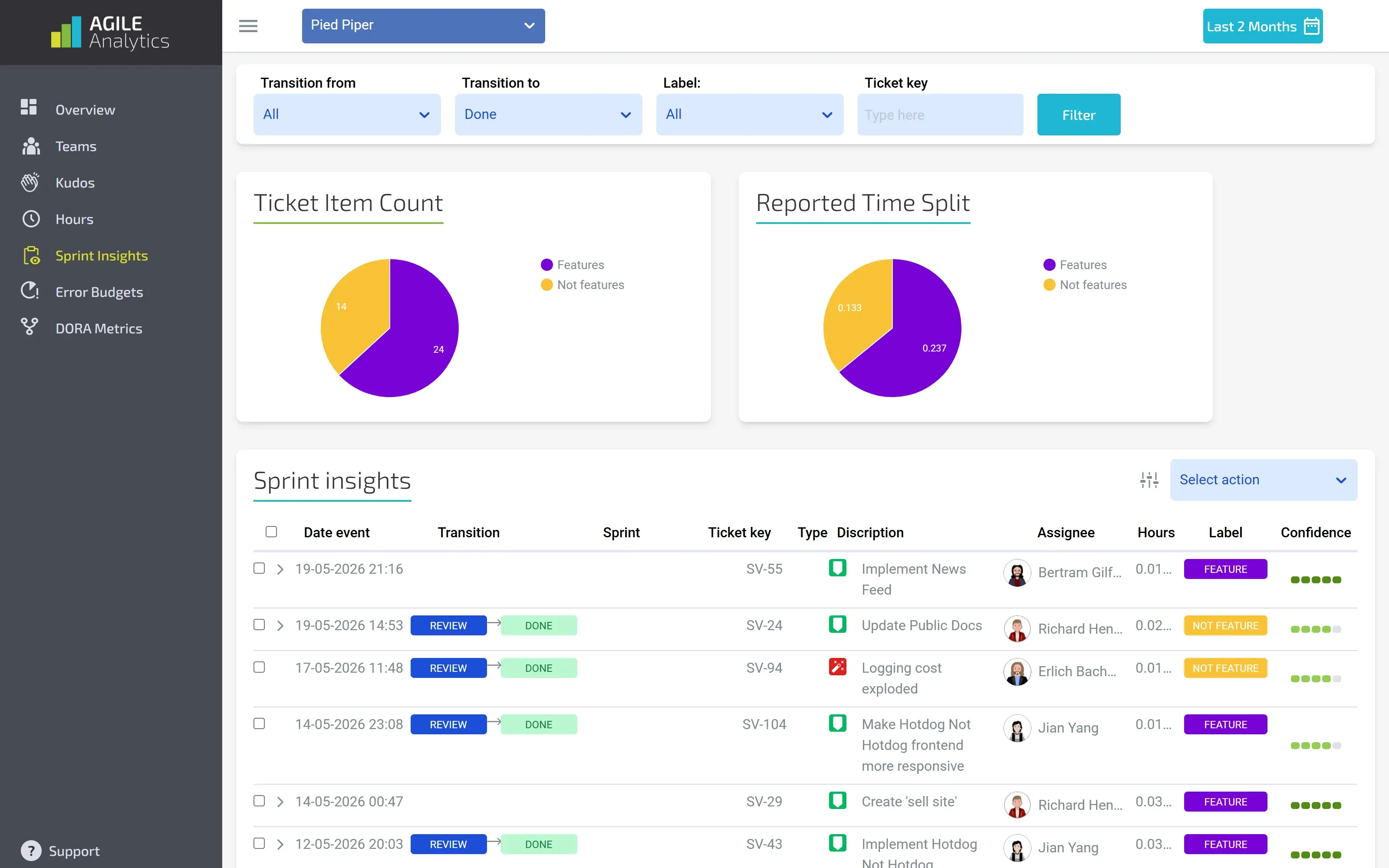
Platforms like Agile Analytics help surface these patterns by continuously analysing ticket systems and workflow behaviour over time. That broader context makes it easier to identify where flow is degrading before delivery problems become obvious at the release level.
Healthy Flow Creates Organisational Trust
One of the less discussed aspects of delivery systems is that healthy flow creates trust.
Teams trust that work will move. Stakeholders trust timelines more confidently. Engineers trust that releases will not require excessive coordination or firefighting. The system becomes easier to reason about because work behaves predictably.
When flow health declines, that trust erodes gradually. More tracking appears. More escalation paths are introduced. Teams begin compensating for unpredictability with additional process layers, which often increases friction further.
This is why ticket flow and ticket age deserve more attention than they usually receive. They are not merely operational metrics. They are early signals describing how much friction the organisation is accumulating while trying to deliver software.

Less guessing. More shipped software.
Measure faster — lead time, review wait and deployment frequency per team, every sprint
Guard quality — change failure rate, MTTR and Error Budgets
Prove the gain — feature work versus maintenance, from your own data
See it in 30 minutes — on your own data, not a slide deck